
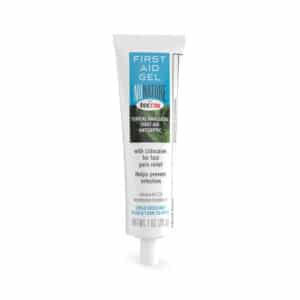



StaphAseptic® First Aid Antiseptic / Pain Relieving Gel
Help Protect Yourself from Skin Infections
Applied to minor cuts, scrapes and abrasions, StaphAsepticŪ can help prevent skin infections caused by bacteria such as MRSA, staph, and other germs, and it contains Lidocaine for effective pain relief.
StaphAseptic is available in a 2oz. tube or single use packets.
Use StaphAseptic as part of a complete staph prevention program to help protect you and your family from skin infections.
Staph Prevention Program:
Treat and cover wounds
Don't share personal items (like towels)
Shower after physical activity
Properly clean gear and equipment
Keep hands clean
Consult your physician for all active wounds
If you think you may have a skin infection, contact your physician immediately. Staph bacteria, including MRSA, can cause skin infections that may look like a pimple, boil, or ingrown hair and can be red, swollen, painful, or have pus and other drainage. Serious infections may cause pneumonia, bloodstream infections, or even death.
To see our product label including ingredients, directions and warnings, click here.
"I requested a free sample of StaphAseptic a while ago and it arrived very promptly.
My immune system has been trashed by Fibromyalgia, plus all the meds I have to take to control it. My primary care physician counsels me very strongly that I am to immediately treat even the most minor housework / gardening-related skin wound as if it were life-threatening, because, as she says, in my case, it could be. She particularly fears MRSA infections among her at-risk patients (diabetics, HIV-positive, chemo-treated, med-trashed, et al ).
Shortly after I received my sample packet of StaphAseptic, I got a small but deep cut on my finger while washing dishes and being less than careful about handling a steak knife in the dishpan. I washed the wound thoroughly with antiseptic soap, dried it with a paper towel, applied your product, and then covered it with a Band-Aid. I repeated this procedure several times a day; by the end of the fourth day, the wound was totally healed, and I experienced absolutely no threat of infection whatsoever.
I daily rub a dab of StaphAseptic into a chronic hangnail area on my thumb -- it has softened the thick tissue there and I no longer experience the painful (and Doctor-upsetting!) pre-infection reddening and irritation of that area. A very little of your product goes a very long way -- I'm only now running out of the contents of that sample packet! (Personally, I like the strong medicinal smell of StaphAseptic: as my gran'ma used to say, "the stronger a nostrum smells, the stronger it works") :)
A full-size supply of StaphAseptic is at the top of next weekend's shopping list, which reminds me to thank you for being so generous with your coupons (I am on SS disability income, so every price-break I can get is deeply appreciated)."
-A. Higgins
"I wanted to thank you for formulating and making StaphAseptic gel! I am currently serving in support of our military in Iraq and I have had 5 staph infections while here, all resulting in painful boils. I finally got serious about finding a product that would effectively knock these infections down, as everything the military has provided is pretty much useless... Since then, I have had two more infections start, but after applying StaphAseptic, they vanished without ever making it past the pimple stage. I have shared this product with others out here and they have had the same wonderful result. I have never had boils before in my life, but the bacteria in Iraq seems to be particularly aggressive and nasty. Your product is a life saver for me and I am hoping to slowly build up a good supply to share with as many other deployed personnel as I can while I am here.
Thank you for a great product!"
-J. H. Gaskill, M.S., CLPE
"I would just like to thank you for making this product it has helped my 2yr. old son and myself tremendously!! Last year my son had bites on his legs that turned into blisters and after having them for 2 1/2 weeks i took him t a local health dept. Two doctors at that facility told me it was just chicken pox! I made it clear that i knew it wasn't chicken pox and said "your the doctors right"..... after two months we took him to the hospital who said it was staph also known as MRSA and that he was now a carrier. we were in the hospital for a week before it was cleared up. Come to find out my son is allergic to insect bites, and from him scratching them it turned into infantigo, and from the dirt around the property turned into staph.... which we are still fighting it to this day..... any little bite, and now that we use staphaseptic on every bite as soon as we see it, it stops it before it starts. Once again thank you so much...."
-N.Frakes, Bakersfield, CA
"I just wanted you to know that this product is wonderful& Everyone is impressed. The nickname for this at the home health agency that I work for is now the "magic dust"&I have talked to our corporate nurse to request that we get this on hand for our patients. I primarily work with wounds and have for several years, and I have never seen anything quite like this."
Thanks again!
-R.Seaton, RN
Disclaimer: Testimonials appearing on this site are real life experiences of those who have used our products. These are individual results, and we do not claim they are typical results that consumers will generally achieve.
Frequently Asked Questions
What is Staphylococcus aureus (staph)?
Staphylococcus aureus, referred to commonly as staph are bacteria commonly carried on the skin or in the nose of healthy people. Approximately 30%-50% of the population is colonized (when bacteria are present, but not causing an infection) in the nose with staph bacteria. Sometimes, staph can cause skin infection. Historically, staph infections occurred among persons in hospitals and healthcare facilities but now they are rapidly spreading into the general population and are easily spread from person to person.
What is MRSA (Methicillin-resistant Staphylococcus aureus)?
Some staph bacteria have mutated and cannot be killed with commonly used antibiotics. MRSA is a type of staph that is resistant to antibiotics including methicillin and other more common antibiotics such as penicillin and amoxicillin. Millions of people are colonized with MRSA in the U.S. alone and infections are appearing at epidemic rates. MRSA infections are commonly mistaken as spider bites.
What is community-acquired MRSA (CA-MRSA)?
Staph and MRSA can cause illness in persons outside of hospitals and healthcare facilities. MRSA infections acquired by persons who have not been recently hospitalized, or had a medical procedure, are known as CA-MRSA infections. Staph or MRSA infections in the community are usually manifested as skin infections, such as pimples and boils, and occur in otherwise healthy people.
What does a staph or MRSA infection look like?
Staph bacteria, including MRSA, can cause skin infections that may look like a pimple, boil or ingrown hair and can be red, swollen, painful, or have pus and other drainage. Many occur in the armpits, neck, groin and buttocks where bacteria grow. More serious infections may cause pneumonia, bloodstream infections, or even death.
How is MRSA spread?
Any open wound is a potential entry point for MRSA. Factors that have been associated with the spread of MRSA skin infections include: close skin to skin contact, openings in the skin such as cuts or abrasions, contaminated items and surfaces, crowded living conditions, and poor hygiene.
Kids playing sports are at greater risk because they share equipment and have skin contact which are both common causes of infections.
How can I help prevent staph or MRSA skin infections?
Practice good hygiene including:
Keep your hands clean
Treat minor cuts and scrapes with StaphAseptic® First Aid Antiseptic / Pain Relieving Gel
Keep cuts and scrapes clean and covered with a bandage until healed
Shower after physical activity
Properly clean gear and equipment
Consult your trainer/physician for all active wounds
Avoid contact with other peoples wounds or bandages
Avoid sharing personal items such as towels or razors
What should I do if I think I have a staph or MRSA infection?
Contact your healthcare provider immediately. Make sure you ask to have your wounds cultured for MRSA.
Are staph and MRSA infections treatable?
Yes. Most staph and MRSA infections are treatable by intravenous antibiotics or by draining the abscess or boil. Draining of skin abscesses or boils should only be done by a healthcare provider. Casual use of antibiotics should be discouraged and can lead to a lack of effectiveness.
Is it possible that my staph or MRSA skin infection will come back after it is cured?
Yes, it is possible for a staph or MRSA skin infection to come back after it is cured. To avoid this, follow your healthcare providers directions while you have the infection, and follow the prevention steps after the infection is gone.
If I have a staph or MRSA skin infection what can I do to prevent others from getting infected?
Cover your wound with clean, dry bandages and follow your healthcare providers instructions on how to take care of the wound.
Clean your hands frequently.
Do not share personal items such as towels, washcloths, razors or clothing that may have had contact with the infected wound or bandage.